


While most of our readers are couples planning their weddings or engagements, we do have quite a few wedding vendors who enjoy Equally Wed’s articles as well. One of the questions I get asked at most any function I speak at is: “How can I make my wedding business more gay-friendly?” The term I created is equality-minded wedding vendor. Let’s talk about the evolution from appreciating and supporting marriage equality to putting your beliefs into action with your current and future customers.
So, I thought I’d take a moment to answer that question the way I do in those conversations for everyone to have a better sense of understanding of how to make your gay, lesbian and transgender clients feel at ease when working with you.
It’s a matter of dos and don’ts, really.
DO
Know that not everyone wants to be referred to as a bride or a groom. Some members of our LBGTQ+ community don’t identify with a gender or feel a connection to more than one gender. Both terms can be restrictive. And some of us feel that the term bride is both antiquated and antifeminist.
Change all your materials (website content, brochures, all contracts) to reflect gender-neutral terms, i.e. the couple, you and your partner, partner A and partner B (in forms and contracts).
Be respectful to both partners, and treat them with as much courtesy and respect as you would for your heterosexual clientele.
Do consider showing your support by becoming an Equally Wed vendor or venue and furthering your education in being an inclusive equality-minded wedding professional with the Equally Wed certified wedding pro course. This will ensure your LGBTQ+ clients feel comfortable right from the start, and it helps educate your straight clients, as well. Proud allies are very influential.
DON’T
Don’t make jokes, i.e. “Who’s the bride?” Whether your intentions are good or not, what comes across is “I’m so stuck in my self-righteous ideas of what a wedding consists of that I will never be enlightened enough to realize that love is love, and nothing else matters.”
Don’t ask offensive questions, i.e. “Are your parents supporting this?” (Whether they are or not is simply none of your business, and your question implies that you think the parents or anyone else has a right not to be supportive of this relationship.)
Don’t isolate your services to LGBTQ+ clients by relegating your offerings to a section for commitment ceremonies, gay weddings or same-sex weddings. It’s akin to offering your same-sex couples the opportunity to drink out of a water fountain with a sign above it that reads, “Gays Only.” Not cool.
Don’t ever use the term lifestyle when speaking about someone’s sexual orientation or gender identity. This is not a style of life. This is a genetic, innate part of who we are. We were born this way. A lifestyle is a choice, and being LGBTQ+ is not. Your use of the term implies that you think otherwise.
Don’t assume anything. Don’t assume that a masculine woman is going to don a wedding gown or that a less masculine man is going to, either. But don’t be surprised if they do. It’s just better to ask what they’re planning for their attire, and respond in a respectful manner. People of all orientations dress how they’re most comfortable – on and off their wedding day. The same goes for a couple’s preference for two boutonnieres, two bouquets or one of each. Just ask simply what the couple is thinking for their flowers or cakes. Let them tell you instead of implying what you think they should do.
Don’t ask if this is legal. Don’t say “but this won’t be legal.” A wedding is a ceremony of marriage, a commitment of two consenting adults who love each other and are promising their lives to one another. It does not require a trip to the courthouse. Hundreds of thousands of same-sex couples around the world are holding wedding ceremonies without a legal marriage certificate because it’s the right time for them to commit to each other—with or without the government’s recognition of it. If you’re concerned that your clients aren’t getting full marital rights as a gay or lesbian couple, make sure you speak out on their behalf, give money to organizations such as Lambda Legal, Freedom to Marry and the Human Rights Campaign, and, of course, vote for marriage equality.
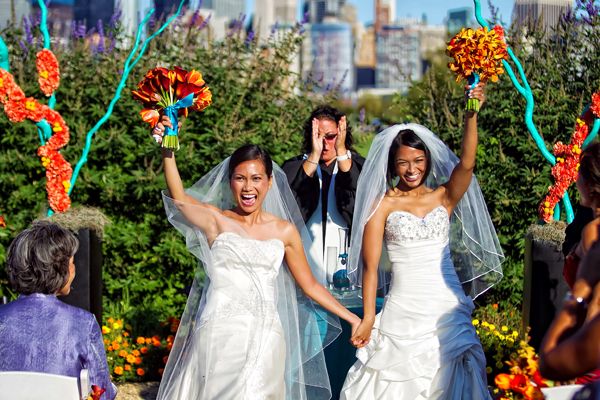
Photo: Ron Soliman Photojournalism