

Do I have to choose sides?
by Jennie Gruber for A Practical Wedding (where this post first appeared)
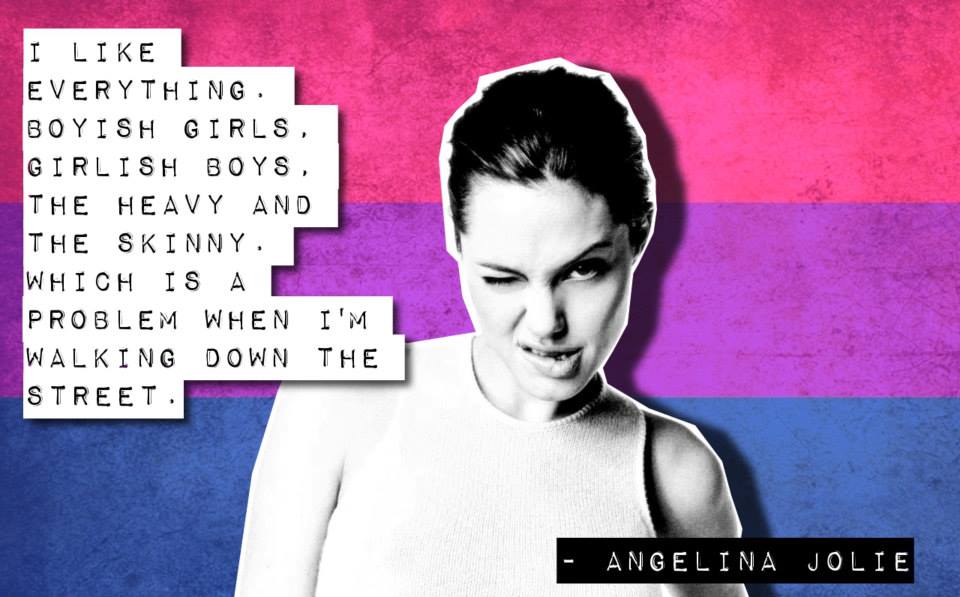
[dropcap letter=”I”]’ve always been uncomfortable with the word “bisexual,” even when “equally attracted to men and woman” was obviously the kind of person I was, from mischievous childhood through horny adolescence and into my adult love life.
In retrospect, I am able to admit that my aversion to the word was based on a very ’90s mainstream conception of sexual orientation. When I was a teenager, my peers and the media told me that bisexual people were flaky sluts who didn’t really belong anywhere. Bisexual desire wasn’t real. Bisexual identity wasn’t legit. Sadly, I bought into those myths early on by reinforcing hierarchies: I might be attracted to everyone, but I wasn’t one of those bisexual people. I claimed I didn’t like labels, but I really just didn’t want to be judged.
Everyone assumed I was a lesbian before I could define my own identity, and I resented that. Both culturally, and gender-wise I was very queer, running with the theater kids and favoring Winona Ryder pixie cuts. Yet I took refuge in my potential for hetero privilege. I mostly dated, slept with, and loved cisgender men from my teens through the age of twenty-five. I was, frankly, being a punk ass, defiantly responding to everyone who assumed I was gay by demonstrating: “You think you can put me in a box! I’ll show you by sucking all the dicks!”
As a young adult, I chased sex, community, romance, partnership and adventure.
I never, ever dreamed of marriage.
Around the age of twenty-six, I discovered the identity queer. Suddenly I had a word for what I was: an anti-conformist who desired relationships with people of all genders. In the mid-aughts Bay Area where I lived, queer was a word that could mean bisexual or pansexual or kinky. It was a term for iconoclasts, a term that welcomed sex workers and exhibitionists. It was the identity that declared: “Not gay as in happy; queer as in fuck you.”
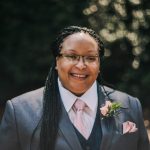
I was thirty when I met my future wife, at Bluestockings, the anarchist-feminist bookstore in Manhattan’s Lower East Side. Genderwise, she’s got it all. She’s a butch lady with a tie collection, who can hit all the high notes when she sings Cyndi Lauper at karaoke. A mutual sexual obsession grew into love, and then conversations about commitment; and then, a proposal in a gritty downtown park with a gold-plated cock ring, the perfect confluence of rational pragmatism and filthy romance.
We love to joke about the fact that homo means same, and that we’re not so much attracted to each other as women who love women, but as women who love people of all genders. A huge part of my attraction to my wife—who I married one year ago in a NYC civil ceremony—is a kindredness in queerness. My wife and I are both dykes who feel like gay men, butch-leaning women who love flamboyance and sparkly things and spontaneous disco dance parties. If I can explain why I knew I wanted to marry her after never wanting to get married, this is why: I fell in love with her but I also fell in love with the prospect of a queer life and marriage together.
Our wedding—which we are calling our Lovefest to try to banish words that limit us—is this month on a farm in Maine. It’s going to be a queer wedding, and it doesn’t confirm or deny our sexual identities. It just means we’re going to continue to grow in them together. It’s going to be a wedding with trans*, cis, and genderqueer guests, hetero couples and queer triads, and a gay officiant. A lot of our exes will be there. I’m going to wear a custom blue dress in the afternoon and a three-piece suit at night, because complicated genders require costume changes.
Being queer, and unquestionably anti-establishment, my wife and I have had to field a lot of questions about our decision to get married and what it says about our identity. Does this make us “officially” lesbians? Are we “over” our bisexual “phase”? Do we have to turn in our queer cards because we decided to “assimilate”?
Of course the answer to all of these questions is, “No and fuck you very much.” I identify as queer because I get to decide what it has meant and continues to mean to me. Committing to my wife does not mean abandoning my community. Sharing a bed and home with a woman doesn’t mean I’m abandoning my love of other genders.
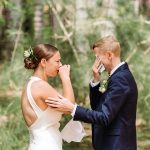
Brekken + Carter’s Wedding | Photography by Jessica Hill, A Brit and a Blonde
If my wife and I decide to be monogamous, or if in our monogamishmash I never end up playing with another cis man, trans man, trans woman, or genderqueer person, I’m still bisexual. Or queer. Or whatever I am.
I didn’t stop being attracted to men or transpeople when I married a ciswoman. It’s also not a problem if I “miss” other genders. I love my lady because she loves men and people of all genders too. I could never be married to someone who excluded an entire gender, socially or sexually. I can check a man out on the street and murmur dirty things to her—if she didn’t notice him first. That is more important to me than actually sleeping with anyone else—the ability to be honest about my erotic imagination, to be funny, to acknowledge attention and share fantasies. My wife is secure in our love, commitment, mutual lust, and she isn’t threatened by my male friends or the ex-boyfriends I’m close with.
Also my wife’s gender contains multitudes: A doting wife. A stern husband. A playful girl. A dirty pig. She’s a Gemini. In that way, she is the perfect match for a queer girl like me: she can be all the genders I’m hot for and wired to love, all wrapped up into a perfect package that I’ve been lucky enough to marry.